



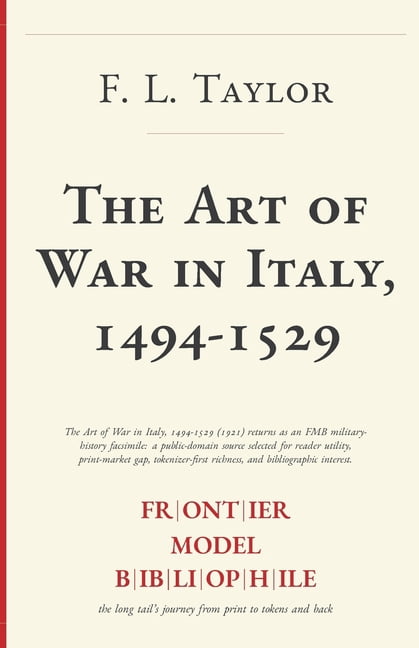
Frontier Model Bibliophile The Art of War in Italy, 1494-1529, (Paperback)

 4.4 (107 items)
 Limited Time Sale
US$14.99 cheaper than the new price!!
Free cash-on-delivery fees for purchases over $99
Product details
| Management number | 240222734 | Release Date | 2026/07/16 | List Price | US$10.00 | Model Number | 240222734 | ||
|---|---|---|---|---|---|---|---|---|---|
| Category | |||||||||
The Italian Wars of 1494 to 1529 transformed European warfare more profoundly than any conflict since the fall of Rome. When Charles VIII of France led his army across the Alps in 1494, he inaugurated a series of campaigns that turned the Italian peninsula into a laboratory for military innovation, drawing in France, Spain, the Holy Roman Empire, the Papacy, Venice, Milan, Florence, and the Swiss Confederacy in shifting combinations of alliance and enmity. This scholarly study examines the art of war as it was practiced and transformed during these decisive decades, tracing the evolution of tactics, fortification, and military organization that would define European conflict for centuries to come. The text addresses the full spectrum of military change that the Italian Wars catalyzed. The condottieri system of mercenary warfare, which had dominated Italian military practice for a century, collided with the French gendarmerie and Swiss pike formations and was found wanting. Artillery, previously a siege weapon of limited tactical utility, became decisive on the battlefield as French guns demonstrated their killing power at Fornovo, Ravenna, and Marignano. The Spanish tercios began their evolution toward the infantry formations that would dominate European battlefields for the next century and a half. Fortification design underwent a revolution as the medieval castle proved helpless against gunpowder siege trains, giving rise to the trace italienne bastioned fortress that would reshape both warfare and urban planning across Europe. The author brings focused scholarly attention to a period that general military histories often treat as a transitional footnote between the Middle Ages and the era of pike and shot. By examining the Italian Wars as a coherent subject rather than a prelude to something else, the study reveals the speed and drama of military transformation when competing powers are forced to innovate or die. City-states that had maintained independence for centuries fell in weeks. Commanders who mastered one mode of warfare found it obsolete within a decade. The political fragmentation of Italy made it both the prize and the proving ground for every major military innovation of the early sixteenth century. Modern readers will find this work valuable for its precise focus on a period of extraordinary military change. Students of Renaissance history gain a military dimension that complements the more familiar cultural and political narratives. Wargamers and military enthusiasts encounter detailed descriptions of formations, tactics, and siege operations drawn from contemporary accounts. Historians of military technology can trace the co-evolution of offensive and defensive innovations that the Italian Wars compressed into a single generation. The Frontier Model Bibliophile edition preserves this focused monograph in a contemporary format, maintaining the original scholarship while making it accessible to collectors and researchers interested in the military revolution of the early modern period.
- Frontier Model Bibliophile The Art of War in Italy, 1494-1529, (Paperback)
- Author: F L Taylor
- ISBN: 9798259502710
- Format: Paperback
- Publication Date: 2026-09-22
- Page Count: 268
| Book format | Paperback |
|---|---|
| Fiction/nonfiction | Non-Fiction |
| Genre | History |
| Pages | 268 |
| Subgenre | Military |
| Series title | Frontier Model Bibliophile |
| Number in series | 0 |
| Edition | frontier model bibliophile facsimile Edition |
| Publisher | W. Frederick Zimmerman |
| Language | English |
| Is collectible | N |
| Recording time | 0 min |
| Retail packaging | Single Piece |
| Assembled product dimensions (l x w x h) | 5.50 x 0.56 x 8.50 in |
| Assembled product weight | 0.69 lb |
| Bisac subject heading | History |
Bestseller ranking
Nuclear Warfare Military History Books




Customers who viewed this product also viewed
Flatware Chests




Correction of product information
If you notice any omissions or errors in the product information on this page, please use the correction request form below.
Correction Request Form